ServicesDual Tank Water Filtration
Dual Tank Water Filtration in West Carson
With two media beds sharing the load, a dual tank system lets each bed handle its own task well and wear more slowly. We tie it into your main line with a complete bypass loop, a proper drain air gap and a level base under the tanks.
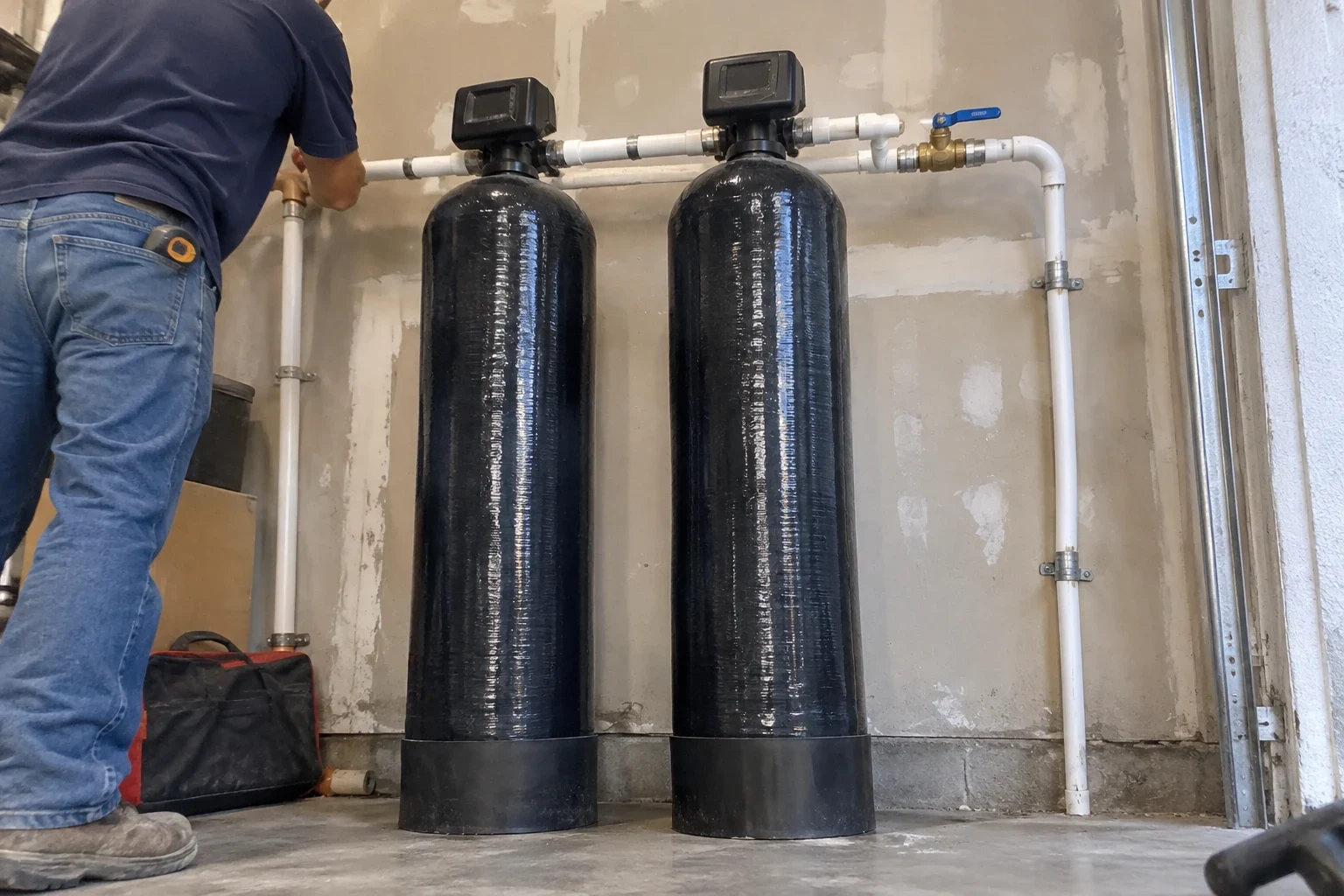
Two Tanks, Two Jobs
A single tank asks one bed of media to do everything. A dual tank system separates the work: the first tank usually holds carbon that strips chlorine taste and odor, and the second tank treats what the first one leaves behind, such as the minerals that leave white scale on faucets and glass shower doors. Because each bed only handles one load, it stays effective longer between service.
How long the system lasts depends less on the tanks and more on how they are connected. A control valve hung on unsupported pipe, a drain line pushed straight into a standpipe, or a tank set on a sloped garage slab will shorten the life of good equipment. Those are the details we spend our time on.
When the real goal is cleaner water for drinking and cooking at the kitchen faucet, an under-sink Reverse Osmosis unit is often the simpler answer. Two tanks on the main line earn their place when you want treated water reaching every shower, appliance and tap in your home.
What the Install Includes
Three-valve bypass loop
We build a bypass with isolation valves on both sides of the system. You can take the tanks offline for service without shutting off water to the house.
Level, supported tanks
Fiberglass tanks rest on a flat pad, not a sloped slab. A leaning tank channels water down one side of the media bed, so part of the media never does any work.
Drain line with a proper air gap
The backwash line runs to an approved drain with a physical air gap, so dirty water can never siphon back into the system. We size and secure the line so it does not kick loose when the valve flushes.
Careful media loading
We cap the distributor tube before pouring, load the gravel underbed first and fill the media in stages. Media in the riser or a crooked distributor is a common reason new systems pass grit.
Start-up rinse and settings
Each tank is filled slowly to push out trapped air, then backwashed until the carbon fines clear. The backwash interval is set from your household size and daily gallon use, so the beds clean often enough without wasting water. Then we show you how to read the display on the control head.
Signs a Dual Tank System Fits Your Home
Chlorine taste at every tap
If the pool smell shows up in the shower as well as the kitchen, a point-of-use filter only fixes one spot. A carbon tank on the main line treats it all.
Scale on fixtures and glass
White crust around faucet aerators and spots on shower doors come from minerals left behind as water dries. Hard water is common across Southern California, and it wears on water heaters and valves over time.
An old single tank that cannot keep up
A one-tank unit sized for a smaller household runs out of capacity between cycles. Taste or spotting comes back before the next regeneration.
Pressure dropped after a past install
Undersized valves or fittings choke flow. If showers got weaker after a filter went in, the plumbing around it is often the cause.
How the Work Goes
- 1
Sizing the system
We count bathrooms and fixtures to set the flow rate the valves need to pass. Then we choose tank sizes so neither bed runs short between cycles.
- 2
Choosing the spot
Most installs go in the garage near the main shutoff. Outdoor installs get a cover, since steady sun breaks down valve housings and tank shells.
- 3
Plumbing in
We cut into the main line, add the bypass loop and transition properly between pipe materials, whether you have copper, galvanized or PEX. Every joint is pressure-checked before the tanks go live.
- 4
Start-up and walkthrough
We flush the system, check the drain connection during a backwash and clean up the work area. Before we leave, you will know how to bypass the tanks and what upkeep to expect.
What Moves the Price
Every system comes with a free install (we cover the cost), so what you pay depends mostly on the equipment your home needs. A short phone call about your home's size and plumbing usually narrows that down. When the setup includes a brine tank, we add free salt provided to tank upon install.
- Tank size and flow rate
- More bathrooms mean larger tanks and a control valve rated to pass more gallons per minute.
- Media type
- Standard carbon, catalytic carbon and the second-stage media each cost differently and wear out at different rates.
- Existing pipe condition
- Aging galvanized pipe close to the shutoff can be too corroded inside to hold a new fitting. In that case we swap out a few feet of it before tying in the tanks.
- Location and drain distance
- An outdoor spot needs a cover, and a long run to an approved drain adds line and fittings.
Dual Tank Questions
Something not covered here? (310) 943-1092
How is a dual tank system different from a single tank?
Each tank holds its own media for its own job, so neither bed is overloaded. That usually means steadier water quality and longer intervals between media changes. It also lets us size each tank for what your water actually needs.
Will it lower my water pressure?
A correctly sized system with full-port valves causes very little drop. Most pressure complaints come from undersized fittings or valves, which is why we size by your fixture count before choosing parts.
What upkeep does it need?
The control valve handles backwashing on its schedule. If there is a brine tank, you keep salt in it. The media is replaced every few years, depending on water use and media type, and we explain what to watch for at the install.
Does it need electricity?
Most control valves run on a small plug-in transformer, so a standard outlet nearby helps. If there is none at the install spot, tell us on the phone and we will plan around it.
Should I also add reverse osmosis?
Some homes pair the two: the tanks treat every tap, and an under-sink Reverse Osmosis unit polishes drinking and cooking water. It is optional, and we will tell you plainly if your home does not need it.
Get the Details Right the First Time
Tell us about your home, your fixtures and where your main line comes in. We will explain which tank sizes and media make sense and why.