ServicesWhole Home Water Filtration
Whole Home Water Filtration in West Carson
We install a point-of-entry system on your main supply line, ahead of every branch, so the kitchen faucet, each shower and the washing machine all draw treated water. The tank is sized to your peak flow and plumbed with unions and a bypass, so later service never means cutting pipe.
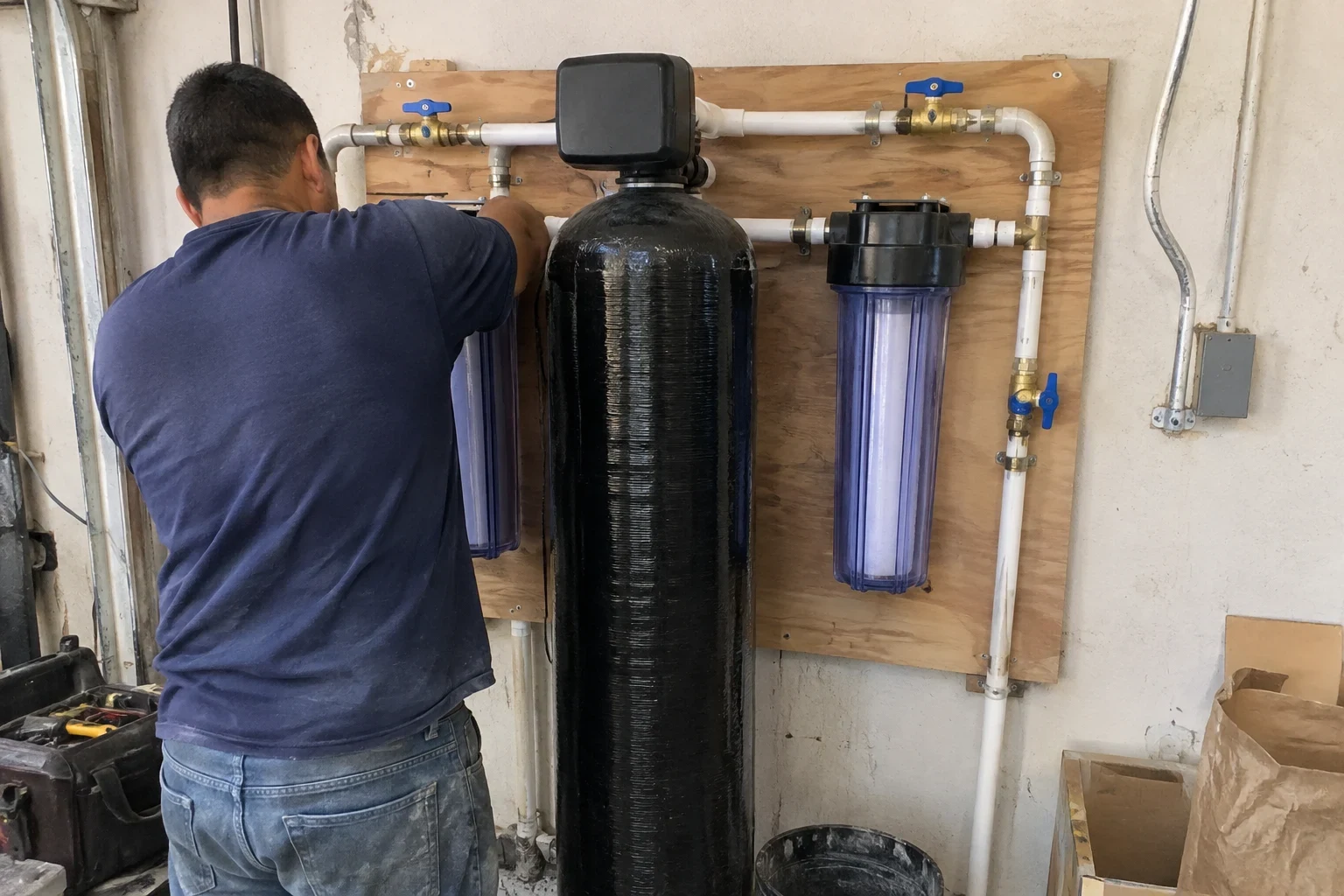
One system at the main line instead of filters at every sink
A whole home system sits where the water line enters your home, usually near the hose bib or pressure regulator. Water passes through a sediment stage and then a bed of filter media before it reaches any branch line. That means the shower, the washing machine and the kitchen tap all draw from water that has already been treated.
Most city water in the South Bay is disinfected and safe to drink. The common complaints are taste, the smell of disinfectant in a hot shower, and sediment that clogs aerators and appliance screens. A whole home system handles those at the source. For drinking water, many homeowners add an under-sink unit from our Reverse Osmosis page as a second stage.
How long the system lasts depends less on the tank and more on the plumbing around it: the bypass, the unions, the bonding jumper and how the drain line is run. That is where we spend our time.
What the installation includes
Sizing to flow, not to a model number
We count bathrooms and fixtures and check your main line diameter, usually 3/4 or 1 inch. The tank and media volume are matched to peak flow so water spends enough contact time in the carbon. An undersized tank lets water rush through partly treated and drops your pressure.
Sediment prefilter
A sediment housing goes ahead of the main tank to catch grit and pipe scale. It protects the carbon bed from fouling, and the cartridge is a quick swap you can do yourself.
Three-valve bypass and unions
We plumb a bypass loop with shutoffs on both sides and threaded unions at the connections. If the tank ever needs service, you turn three valves and keep water running to your home while it is out of line.
Bonding jumper across the cut
Many homes use the metal water pipe as part of the electrical grounding path. When we cut into copper or galvanized line, we install a bonding jumper across the system so that path is not broken.
Dielectric fittings where metals meet
Copper joined directly to galvanized steel corrodes at the joint over time. We use dielectric fittings at those transitions so the connection does not become the weak point.
Pressure gauges and a proper drain
Gauges before and after the system show when media needs attention. Backwashing valves get a drain line with an air gap so wastewater can never siphon back.
When a whole home system is the right fit
Bathrooms smell like a pool
Steam from a hot shower carries the disinfectant out of the water, and a closed bathroom traps it. Only treating water before it reaches the shower line fixes that.
A filter in every room
A fridge cartridge, a pitcher and a faucet-mount filter each have their own change schedule. A single system at the main covers most of that work.
Clogged aerators and screens
Specks building up in faucet aerators, showerheads or the washer's inlet screen tell you particles are traveling through every branch of your plumbing.
An aging tank that robs pressure
When an older system starts choking flow, the media is usually spent or the control head is wearing out. We will tell you whether new media or a new unit makes more sense.
Residue on glass and faucets
Chalky spots left on shower doors and chrome are minerals staying behind as droplets evaporate. The right media can cut them down, and we will be straight with you about how much.
From first call to filtered water
- 1
Start with the phone call
Tell us how many bathrooms you have, what you dislike about the water and where your main shutoff sits. With those answers we can usually recommend a tank size on the call.
- 2
Look over the main line
We note whether the pipe is copper or galvanized, how much room surrounds it, whether an outlet is close for a control valve and where a drain line can go. For an outdoor main, we pick a shaded spot or plan a cover so sun stays off the tank and valve.
- 3
Plumb it in
With the water shut off, we cut in the bypass loop, mount the sediment housing and tank, then add the bonding jumper and any dielectric fittings. Expect the water to be off for a few hours rather than the whole day.
- 4
Rinse the media and pressure-test
Fresh carbon sheds a fine black dust, so we run the bed to drain until it clears before sending water into your home. Every joint gets checked for weeping, and we read both gauges with water flowing.
- 5
Show you the controls
Before we leave, you practice turning the bypass valves, swapping the sediment cartridge and reading the gauges, so a change in pressure means something to you later.
What sets the price of a whole home system
Installation is free (we cover the cost), so the equipment makes up most of your price. Beyond that, it comes down to how much water your household uses at one time and the condition of the pipe at your main. We go over every item with you by phone before anything gets ordered.
- Size of the tank and media bed
- Three or four bathrooms in use together call for a taller tank and more carbon than a modest two-bath home. When the utility uses chloramine we use catalytic carbon, which costs more than standard carbon.
- The right control valve
- A backwashing head needs a power outlet and a drain line close by. A valveless upflow tank needs neither, though it performs well over a narrower band of flow rates.
- Condition of the pipe you have
- When galvanized pipe at the main is pitted or scaled on the inside, we may swap out a short section so the new unions and fittings seal against solid metal.
- Covering an outdoor setup
- Equipment installed outdoors often needs a cover or small enclosure, because steady sun wears down plastic housings and valve electronics over the years.
Common questions about whole home filtration
Something not covered here? (310) 943-1092
Will I notice a pressure drop after the install?
With the tank sized to your peak demand, the drop is slight and most households never feel it at the shower. A drop you can feel usually points to a tank that is too small for the flow or a media bed packed with sediment. Matching the tank to how your home actually uses water is how we keep pressure where it was.
Will it handle chloramine, or only chlorine?
Ordinary carbon breaks down chlorine quickly but needs far more contact time for chloramine. When the local supply uses chloramine, we spec catalytic carbon and a larger media volume so water stays in the bed long enough to be treated.
Is reverse osmosis still worth adding for drinking water?
The whole home carbon bed takes care of taste and odor at every tap and shower. A reverse osmosis unit under the kitchen sink removes much more of the dissolved material, but only at that one faucet. Plenty of our customers run both, and the main-line system ahead of it helps the membrane last longer.
How much upkeep should I plan for?
The sediment cartridge is the part you will touch most, usually a few times a year, when the two gauges start reading further apart. The carbon bed in the main tank runs much longer between changes, and its life tracks how much water your home goes through.
What if my main line comes in outside?
That is common around here, and it works fine. We set the tank on a level base, shade or cover the valve, and wrap or shield any fittings left exposed to sun.
Get the plumbing around your filter built right
Tell us about your home and your water, and we will recommend a system size and explain the install. Your quote comes by phone.